The Dark Factory: What It Means When the Lights Go Off
April 1, 2026 · 10 min read
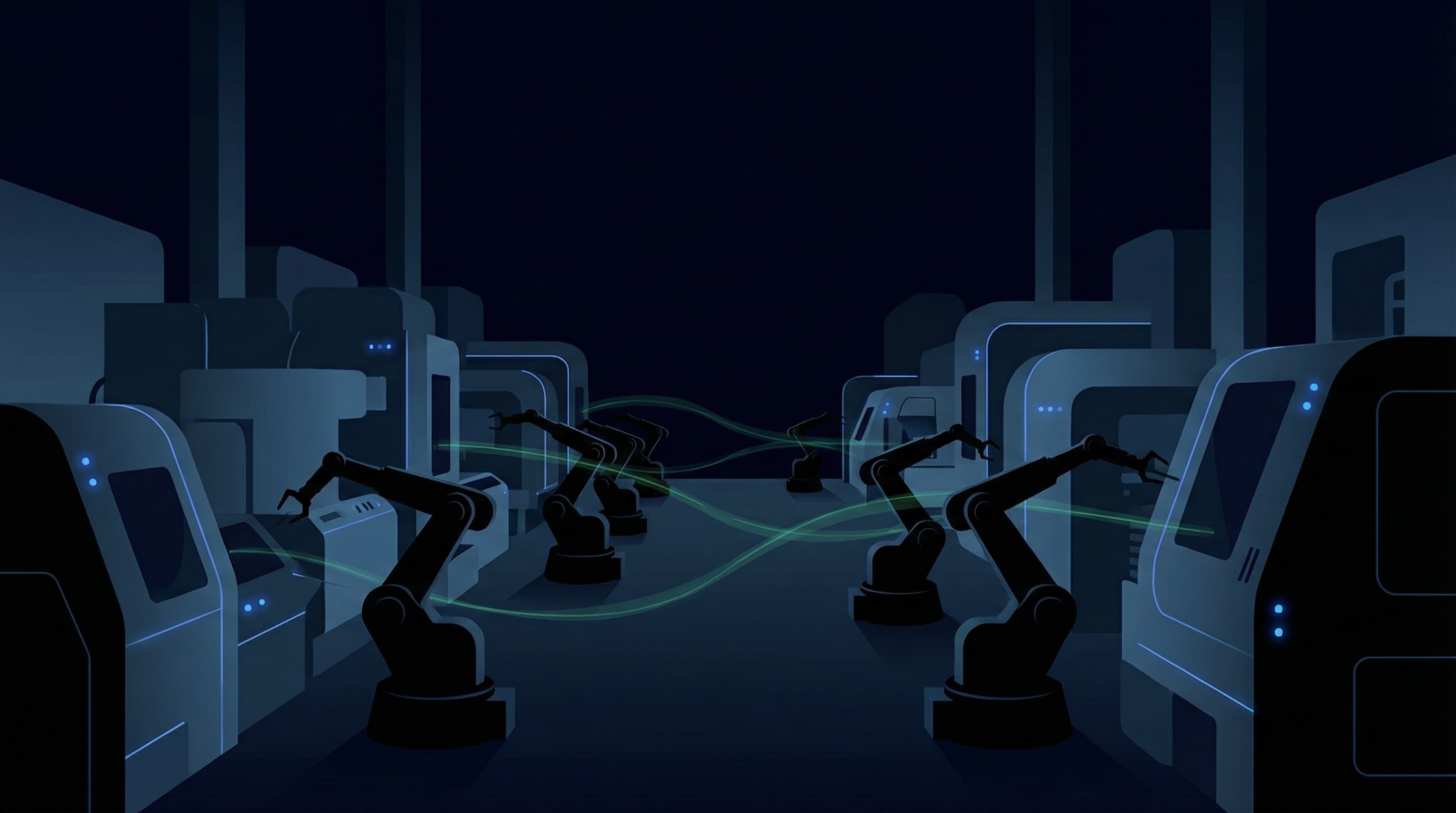
Somewhere in Oshino, Japan, a Fanuc factory builds robots. The robots build other robots. The lights are off. The heat is off. Nobody is on the floor. The facility runs unattended for thirty days at a stretch.
This is what the manufacturing world calls a dark factory — or lights-out manufacturing. The concept is straightforward: when the machines are doing all the work, there is no reason for the lights to be on. Fanuc pioneered it. Toyota and others have applied versions of it. The premise is not that humans are unnecessary. It is that humans should not be doing work that machines can do better, faster, and more consistently.
That idea applies far beyond a factory floor. It applies to how software gets built. And it applies to how your business operates.
Both of those are what we do at Level 5.
How We Build Software: The Dark Factory as a Development Model
Traditional software development is labor-intensive by design. A development firm staffs up a team — senior engineers, mid-level engineers, junior engineers, QA, project managers — and that team produces code through a largely manual process. More complexity means more people. More people means higher cost. Higher cost gets passed to the client, usually with uncertainty about scope and timeline layered on top.
That model has not changed much in thirty years. The cost structure is roughly the same. The risk distribution — client absorbs scope creep — is roughly the same.
Our cost structure is fundamentally different, because our development process is a dark factory.
Here is what that actually means. When we take on an engagement, senior engineers do the work that requires judgment: architecture decisions, system design, edge case identification, technical specification. That part is irreducibly human. No model makes these calls well without someone who understands the domain, the constraints, and the business context.
Everything downstream of those decisions runs differently. Code generation, unit test creation, integration test scaffolding, boilerplate, documentation, deployment configuration, monitoring setup — AI agents handle most of this. Not unsupervised. Not without review. But the volume of implementation work that previously required mid-level and junior engineering hours now happens faster, with greater consistency, and at a fraction of the labor cost.
There are review gates at every meaningful stage. Senior engineers review the architecture before implementation starts. They review the generated code before it is accepted into the build. They sign off on test coverage and deployment readiness. The judgment calls still belong to humans. The mechanical work — the work that can be defined precisely and executed reliably — belongs to the agents.
This is not a different way of doing the same thing. It is a structurally different production model.
The result: we ship in weeks, not months. We price at fixed rates that would not be economically possible for a traditional development shop to offer. The 3PL billing case study on our site tells this story numerically — $55,000 and 10 weeks for a system two other vendors quoted at $135,000 to $160,000 and nine months. The margin difference is not because we cut corners. It is because our cost structure allows it.
Fixed-price engagements are only possible when you have genuine confidence in your own process. We have that confidence because our development environment — the tooling, the agent workflows, the review gates, the testing harness — is controlled and predictable. When a traditional firm encounters unexpected complexity, the hours go up and so does the invoice. We encounter unexpected complexity and deal with it inside our model. That risk is ours, not yours.
The lights are off. The work gets done.
What a Dark Factory Looks Like for Your Business
The manufacturing analogy translates directly to business operations. Look at the processes that run in your business every week. Invoicing. Inventory reconciliation. Report generation. Data entry between systems. Status updates to stakeholders. Exception flagging.
Almost all of these share a common structure: structured inputs, defined logic, predictable outputs. They are not intellectually interesting work. They are high-volume, repetitive tasks that eat your team's time and attention. And because humans are executing them, they are subject to human variability: errors, delays, forgotten steps, inconsistency on a bad day.
A dark factory for your operations means these processes run themselves. The lights go off. The work still gets done.
It does not mean nobody reviews anything. A dark factory is not an unsupervised system. It means the work happens automatically, exceptions surface to the right person, and humans are involved only where judgment is actually required — not where data is being moved from column A to column B.
Here is what this looks like in practice, based on actual work we have delivered.
Billing that runs itself. The 3PL billing engagement we completed replaced a system that required manual intervention at multiple stages of the invoicing cycle. Someone had to touch every invoice before it went out. Now, the billing engine reads from the ERP, applies the rate logic, generates the invoice, validates it against defined rules, and sends it. If something is outside normal parameters — a charge that exceeds a threshold, a customer record that does not match — the system flags it and escalates. A human reviews the exception. Not the invoice. The exception.
That is a dark factory billing operation. The lights are off. Invoices go out. Humans deal with the edge cases.
Inventory that knows where it is. The vehicle inventory platform we built for a regional manufacturer replaced a process that required someone to manually check spreadsheets, take phone calls from dealers, update availability records, and reconcile holds across multiple lists that were often out of sync. That was twenty-two and a half hours a week of management time. Every week. On work the system should have been doing.
Now the system tracks every unit through every production stage. Dealers log in and see real-time availability. Orders create records automatically. Holds expire without anyone following up. Profit margins calculate as production costs are entered, not at the end of the month when someone runs the numbers. The management team reclaimed twenty-two and a half hours a week. The lights are off. The inventory knows where it is.
Dark Factory Does Not Mean No Humans
This is the fear worth addressing directly, because it is usually what stops the conversation.
When you hear "autonomous operations" or "the work runs itself," the instinct is to hear "no one has a job anymore." That is not what this means, and the businesses that have implemented these systems are not evidence of it.
The 3PL client did not reduce headcount. They redirected attention. The people who were manually touching invoices are now dealing with the exception cases — the customers with disputes, the unusual billing arrangements, the relationship management that actually requires a human. That work is more valuable. It is also, frankly, more interesting.
The vehicle manufacturer did not reduce headcount. The twenty-two and a half hours reclaimed went back into the business in ways that mattered: dealer relationships, production planning decisions, expansion strategy. Work that had been crowded out by the administrative overhead of manual tracking.
The dark factory does not eliminate humans. It eliminates the parts of work that degrade humans — the repetitive, the mechanical, the administrative. What remains is the work that humans are actually good at: judgment, relationships, strategy, the decisions that require context that cannot be codified into a rule.
Humans do the thinking. Not the typing.
This Is What Level 5 Looks Like
Our maturity framework runs from Level 1 — everything on human effort, manual processes, disconnected systems — up through Level 5, which we define as AI Automation: AI autonomously produces business output with human oversight at decision points only.
A dark factory operation is Level 5. Not because it is the most sophisticated technology available, but because it represents the correct division of labor. Machines doing what machines are good at. Humans doing what humans are good at.
Most businesses we talk to are at Level 1 or Level 2. Someone has experimented with an AI tool. There is no structure around it, no integration, no measurable output. The potential is visible but untapped.
Getting from Level 1 to Level 5 is not a single leap. It is a progression. Level 3 is AI helping with specific tasks. Level 4 is multi-step workflows where humans review and approve but do not execute the steps. Level 5 is the full lights-out operation — structured, monitored, validated, with human judgment applied only where it adds value.
The path matters. Companies that try to skip from Level 1 to Level 5 without building the intermediate infrastructure usually fail. The data is not clean enough. The processes are not documented well enough. The edge cases are not understood well enough. The jump is too large without the intermediate steps.
The companies that succeed take it one process at a time. They pick one workflow, build it right, measure the outcome, and use that as a foundation for the next one. Invoicing first. Then inventory. Then reporting. Each one narrows the gap between where they are and where they want to be.
What It Takes to Get There
Three things determine whether a business can build a dark factory for its operations.
First, process clarity. You cannot automate something that is not defined. If the billing logic lives in someone's head, you have to extract it before you can systematize it. If inventory is tracked across three spreadsheets maintained by two people with slightly different conventions, that ambiguity has to be resolved before automation can enforce consistency. This is the hardest part for most businesses, and it is where the most important work happens before any code is written. Our 3PL engagement started with two weeks of audit: every billing flow, every edge case, every manual override, documented before anyone wrote a specification. The vehicle inventory engagement started the same way — mapping every workflow, every person involved, every place data lived.
Second, system access. The automation needs to be able to read from and write to the systems where your data lives. Most SMBs have this already — an ERP, an accounting platform, a CRM — but the data is often siloed and inaccessible programmatically. The first step is usually connectivity, not sophistication. You do not need a data lake. You need the right integrations and consistent data conventions across your existing tools.
Third, the right scope. A dark factory for your billing operation is a different project than a dark factory for your entire business. The businesses that get there start narrow. One process, one workflow, one measurable outcome. They build confidence in the system, capture the ROI, and expand from there. The instinct to automate everything at once is understandable and reliably counterproductive. You do not know which assumptions were wrong until the first system is live and handling real volume. Start small enough that you can learn from it.
The Level 5 AI Maturity Assessment exists to map exactly this: where you are across five dimensions of your operation, what is worth automating first, and what the realistic path looks like given your current infrastructure. Not a generic framework applied generically. A specific diagnosis of your specific business.
The lights are off at Fanuc's robot factory. They have been for decades. The only question for your business is which processes are ready to run that way — and how long you want to wait before you start.
Not sure where your operation stands or what's worth automating first? Take the free assessment or book a discovery call.
Find out where your business stands.
Take the free AI Maturity Assessment — 25 questions, your score, and a roadmap.
Get the Free Assessment